If you've ever done every FOIL step correctly and still got the wrong answer, a negative sign was probably the reason. Negatives cause more lost points in binomial multiplication than anything else, because each one has to survive four separate products and then a round of combining. The good news is that a handful of sign rules handle every case, and you can predict the signs of your answer before you multiply anything. This guide shows you how, with six fully worked examples and ten practice problems with answers.
This post focuses only on signs. For the method itself, see the FOIL method guide.
The Sign Rules You Need
Every product in FOIL is one number times another, so you only need the multiplication sign rules:
- positive × positive = positive
- negative × negative = positive
- positive × negative = negative
- negative × positive = negative
In short: same signs give a positive, different signs give a negative.
The second rule you need is about subtraction. In a binomial like x − 5, the minus sign belongs to the 5. It helps to read it as x + (−5). Then every product is a multiplication of two signed numbers, and the rules above do the rest.
The third rule is for combining the middle terms. Adding numbers with the same sign means adding their sizes and keeping the sign: −3x + (−5x) = −8x. Adding numbers with different signs means subtracting the sizes and taking the sign of the larger one: 7x + (−3x) = 4x.
Predict the Signs Before You Multiply
When both binomials start with x, as in (x + b)(x + d), you can know the signs of the answer in advance. The Last term is b times d, and the middle coefficient is b plus d. This chart covers all four possibilities:
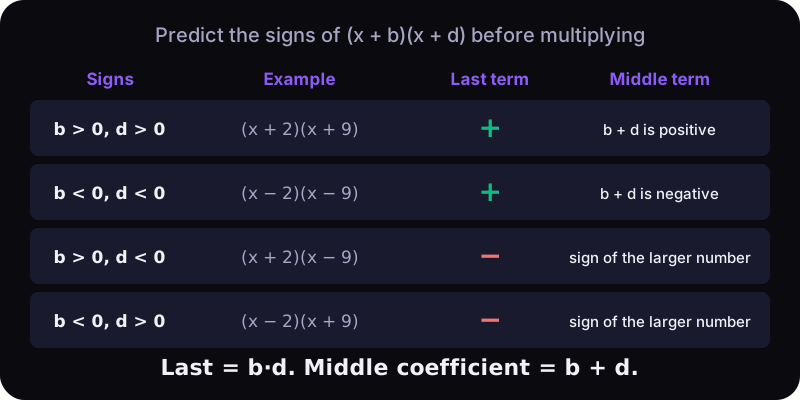
For example, in (x + 2)(x − 9) the constants have different signs, so the last term must be negative. The middle coefficient is 2 + (−9) = −7, so it takes the sign of the larger number, 9. If your answer has a positive last term, you know straight away that something went wrong.
Worked Examples: FOIL With Negative Numbers
Example 1: One negative constant
(x + 7)(x − 3). Read it as (x + 7)(x + (−3)).
- First: x · x = x²
- Outer: x · (−3) = −3x
- Inner: 7 · x = 7x
- Last: 7 · (−3) = −21
- Combine: −3x + 7x = 4x. Answer: x² + 4x − 21.
Check with the chart: different signs, so the last term is negative, and the middle takes the sign of 7, which is positive.
Example 2: Two negative constants
(x − 8)(x − 5).
- First: x · x = x²
- Outer: x · (−5) = −5x
- Inner: (−8) · x = −8x
- Last: (−8)(−5) = 40
- Combine: −5x + (−8x) = −13x. Answer: x² − 13x + 40.
Two negatives make a positive last term, but the middle term stays negative, because you're adding two negatives.
Example 3: A negative leading term
(−x + 3)(x + 6). The first term of the first binomial is negative, which affects the First and Outer products.
- First: (−x) · x = −x²
- Outer: (−x) · 6 = −6x
- Inner: 3 · x = 3x
- Last: 3 · 6 = 18
- Combine: −6x + 3x = −3x. Answer: −x² − 3x + 18.
Example 4: Negatives everywhere
(−2x − 5)(3x − 1). Take each product slowly.
- First: (−2x)(3x) = −6x²
- Outer: (−2x)(−1) = 2x
- Inner: (−5)(3x) = −15x
- Last: (−5)(−1) = 5
- Combine: 2x + (−15x) = −13x. Answer: −6x² − 13x + 5.
Example 5: Squaring a binomial with a negative term
(−4x + 1)². Write it as (−4x + 1)(−4x + 1) first.
- First: (−4x)(−4x) = 16x²
- Outer: (−4x)(1) = −4x
- Inner: (1)(−4x) = −4x
- Last: 1 · 1 = 1
- Combine: −4x + (−4x) = −8x. Answer: 16x² − 8x + 1.
The first term is positive even though −4x is negative, because a negative times a negative is positive. A squared binomial always starts and ends with positive terms.
Example 6: A negative number in front
−3(x − 2)(x + 5). Deal with the outside number last.
- FOIL the brackets: x² + 5x − 2x − 10 = x² + 3x − 10.
- Multiply every term by −3: −3 · x² = −3x², −3 · 3x = −9x, −3 · (−10) = 30.
- Answer: −3x² − 9x + 30.
Every sign flips, including the last one, which becomes positive.
Three Sign Traps to Avoid
- Subtracting a whole product. In 10 − (x − 1)(x + 2), expand first: (x − 1)(x + 2) = x² + x − 2. Then subtract all of it: 10 − x² − x + 2 = −x² − x + 12. A common error is changing only the first sign.
- Treating −x as x. In Example 3, the First product is −x², not x². The negative belongs to the term even when there's no number written in front.
- Forgetting that two negative middle products add up. In Example 2, −5x and −8x make −13x, not −3x. Subtracting their sizes only works when the signs are different.
You'll find more errors like these, with diagrams, in the most common FOIL mistakes.
A Quick Way to Check Your Answer
Substitute x = 2 into both the problem and your answer. For Example 4, (−2x − 5)(3x − 1) gives (−9)(5) = −45. The answer −6x² − 13x + 5 gives −24 − 26 + 5 = −45. They match, so the answer is right. If you'd lost a sign somewhere, the two numbers would almost certainly be different.
10 Practice Problems
Expand each product. Predict the sign of the last term before you start, then check the answers below.
- (x − 4)(x + 9)
- (x − 10)(x − 3)
- (x + 6)(x − 11)
- (2x − 7)(x + 4)
- (3x − 1)(3x − 8)
- (−x + 5)(x − 2)
- (−3x − 2)(2x + 7)
- (x − 9)²
- (4y − 3)(4y + 3)
- −2(x − 1)(x − 6)
Answers:
- x² + 5x − 36. Different signs, so the last term is negative; the middle is −4 + 9 = 5.
- x² − 13x + 30. Two negatives: positive last term, negative middle.
- x² − 5x − 66. The larger number, 11, is negative, so the middle term is negative.
- 2x² + x − 28. The middle products are 8x and −7x, which leave just x.
- 9x² − 27x + 8. The middle products are −24x and −3x.
- −x² + 7x − 10. The First product is −x², and the middle products are 2x and 5x.
- −6x² − 25x − 14. All four products are negative here: −6x², −21x, −4x and −14.
- x² − 18x + 81. Write it as (x − 9)(x − 9); the last term is (−9)(−9) = 81.
- 16y² − 9. The middle terms cancel. This is a difference of squares.
- −2x² + 14x − 12. FOIL first to get x² − 7x + 6, then multiply every term by −2.
Got one wrong? Enter it in the FOIL calculator, which colors each of the four products so you can see exactly where a sign went missing. For problems with three terms in a factor, use the box method calculator, and see which method to use when.