
Your teacher shows you three ways to multiply polynomials in the same week, and they all seem to do the same thing. That's because they do: FOIL, the distributive property and the box method always give the same answer. The real question isn't which one is "right," it's which one is fastest and safest for the problem in front of you. This guide puts the three side by side, shows each one on the same problem, and then gives you a simple way to choose. It finishes with practice problems where part of the job is picking the method.
If you haven't met FOIL yet, read the FOIL method guide first. This post assumes you know what the four letters mean.
One Problem, Three Methods
Let's multiply (3x + 2)(x − 5) all three ways and compare.
Method 1: The distributive property
Treat the second binomial as one quantity and distribute it over the first:
- Split the first binomial: 3x(x − 5) + 2(x − 5).
- Distribute 3x: 3x · x − 3x · 5 = 3x² − 15x.
- Distribute 2: 2 · x − 2 · 5 = 2x − 10.
- Add the pieces: 3x² − 15x + 2x − 10.
- Combine like terms: 3x² − 13x − 10.
Method 2: FOIL
- First: 3x · x = 3x²
- Outer: 3x · (−5) = −15x
- Inner: 2 · x = 2x
- Last: 2 · (−5) = −10
- Combine: 3x² − 15x + 2x − 10 = 3x² − 13x − 10.
Method 3: The box method
- Write 3x and 2 down the side of a 2 × 2 grid, and x and −5 across the top.
- Fill each cell with row × column: 3x², −15x, 2x and −10.
- Add the cells and combine the diagonal: 3x² − 13x − 10.
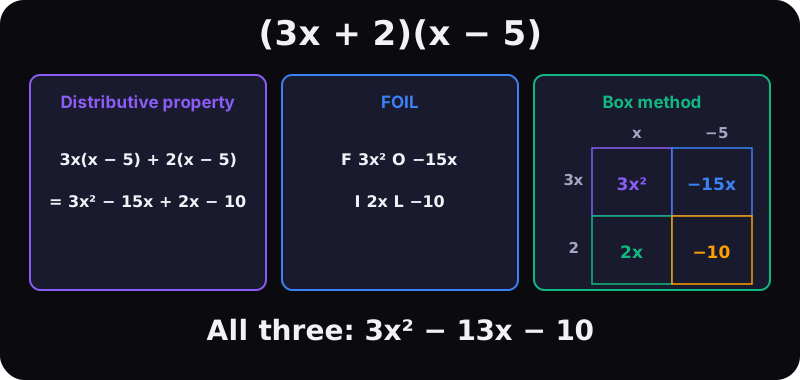
Look closely and you'll see the same four products every time: 3x², −15x, 2x and −10. The methods differ only in how they organize the work on the page.
How the Three Methods Are Related
The distributive property is the actual math rule; the other two are ways of applying it. FOIL is the distributive property for one specific case, two binomials, with a label for each of the four products. The box method is the distributive property drawn as a grid, with one cell for every pair of terms. That relationship explains their strengths and weaknesses:
| Distributive property | FOIL | Box method | |
|---|---|---|---|
| Works for | Any product of polynomials | Two binomials only | Any product, as a larger grid |
| Speed on two binomials | Medium | Fastest | Medium |
| Keeps signs visible | Fairly well | Easy to drop one | Very well |
| Shows like terms | You find them yourself | Usually Outer + Inner | Lined up on diagonals |
| Best for | A single term times a polynomial; three or more factors | Quick binomial problems | Trinomials and messy signs |
When to Use FOIL
FOIL is the fastest choice when you have exactly two binomials and the numbers are small enough to multiply in your head. With practice, you can often write the answer in one line.
Worked example: (x + 9)(x − 4)
- First: x · x = x²
- Outer: x · (−4) = −4x
- Inner: 9 · x = 9x
- Last: 9 · (−4) = −36
- Combine: x² + 5x − 36.
Because both binomials start with a plain x, you can even skip straight to the answer: the middle coefficient is 9 + (−4) = 5 and the constant is 9 · (−4) = −36. Our FOIL calculator shows the same four products if you want to check.
When to Use the Box Method
Switch to the box when a factor has three or more terms, or when there are so many negative signs that you're worried about losing one. The grid gives every product its own cell, so nothing gets skipped.
Worked example: (2x² − x + 3)(x − 2)
This is a trinomial times a binomial, so FOIL can't handle it. Draw a grid with three rows (2x², −x, 3) and two columns (x, −2):
| × | x | −2 |
|---|---|---|
| 2x² | 2x³ | −4x² |
| −x | −x² | 2x |
| 3 | 3x | −6 |
- Fill all six cells, keeping each sign with its term.
- Collect the x² terms: −4x² − x² = −5x².
- Collect the x terms: 2x + 3x = 5x.
- Write the answer in standard form: 2x³ − 5x² + 5x − 6.
The box method calculator draws grids up to 3 × 3, so it can check this one directly.
When to Use the Distributive Property
Plain distributing is the best choice in two situations: when one factor is a single term, and when there are three or more factors.
Worked example: a single term times a trinomial
4x(3x² − 2x + 7). There is no second binomial, so FOIL doesn't apply and a box would be overkill. Distribute 4x to each term:
- 4x · 3x² = 12x³
- 4x · (−2x) = −8x²
- 4x · 7 = 28x
Answer: 12x³ − 8x² + 28x.
Worked example: three binomials
(x + 1)(x + 2)(x − 3). No single method handles three factors in one go, so work in two rounds:
- Multiply the first two (FOIL is fine here): (x + 1)(x + 2) = x² + 3x + 2.
- Distribute that trinomial across x − 3: x(x² + 3x + 2) − 3(x² + 3x + 2).
- Expand: x³ + 3x² + 2x − 3x² − 9x − 6.
- Combine: x³ − 7x − 6. The x² terms cancel completely.
A Quick Way to Choose
- Two binomials, small numbers? Use FOIL.
- Two binomials with lots of negatives? Use FOIL carefully, or use the box if you've been making sign errors.
- A trinomial (or bigger) in either factor? Use the box method.
- One factor is a single term? Just distribute.
- Three or more factors? Multiply two at a time, using whichever method fits each round.
Whatever you choose, the answer has to be the same. If two methods give different results, one of them has an arithmetic slip, and our list of common FOIL mistakes is a good place to look for it.
Using One Method to Check Another
Because the three methods always agree, you can use one to check another. This is especially useful on tests, where you can't use a calculator. Suppose you used FOIL on (4x − 3)(x + 2) and got 4x² + 5x − 6. A fast way to check is to sketch the box instead of redoing FOIL, because the box puts the products in a different layout and you're less likely to repeat the same slip:
| × | x | 2 |
|---|---|---|
| 4x | 4x² | 8x |
| −3 | −3x | −6 |
The diagonal gives 8x − 3x = 5x, so the box agrees: 4x² + 5x − 6. If the two methods had disagreed, you'd know to look more carefully, and you'd have two sets of products to compare, which usually points straight to the mistake. Checking with a different method is a habit worth building, because redoing the same method often repeats the same error.
Practice: Pick a Method, Then Solve
For each problem, decide which method fits best before you start. The answers include a suggested method, but any method that gives the right answer is fine.
- (x − 8)(x + 3)
- 5x(2x − 9)
- (x + 4)(x² − 2x − 1)
- (2y − 3)(4y − 1)
- (x² + x + 1)(x − 1)
- (a − 2)(a + 2)(a + 5)
Answers:
- FOIL: x² − 5x − 24.
- Distribute: 10x² − 45x.
- Box (2 × 3 grid): x³ + 2x² − 9x − 4.
- FOIL or box: 8y² − 14y + 3.
- Box or distribute: x³ − 1. Almost everything cancels, which makes this one fun to check.
- Two rounds: (a − 2)(a + 2) = a² − 4 by the difference of squares, then (a² − 4)(a + 5) = a³ + 5a² − 4a − 20.
Problems with negative numbers are where method choice matters most. For more practice with signs, try the ten problems in How to FOIL With Negative Numbers.